

8 Best AI Sales Use Cases for Revenue Teams
The AI sales use cases that actually move revenue: account research, prioritization, deal-risk detection, forecast inspection, coaching and more.

McKinsey & Company's 2024 report, The State of AI in Early 2024: Gen AI Adoption Spikes and Starts to Generate Value, puts regular generative AI use at 65% of surveyed organizations. The best AI sales use cases are not generic chatbot experiments. They are focused applications that remove friction from the revenue process, give leaders earlier signal, and help sellers spend more time in valuable customer conversations.
For CEOs and revenue leaders, the question is not whether AI belongs in sales. It is where it can improve execution without weakening judgment, customer trust, or accountability. Start with a defined commercial problem, a measurable outcome, and clear human ownership.
AI Adoption Is Moving Into Core Work
The most useful AI applications are moving beyond personal productivity. They are becoming part of how revenue teams prepare for meetings, prioritize accounts, inspect pipeline, coach sellers, and preserve knowledge across the business.
That shift matters because sales organizations rarely struggle from a lack of activity. They struggle when activity is disconnected from buyer intent, the CRM does not reflect reality, and managers discover risk too late to change the outcome. AI can identify patterns faster than a manual review. Your leaders still decide what the pattern means and what to do next.
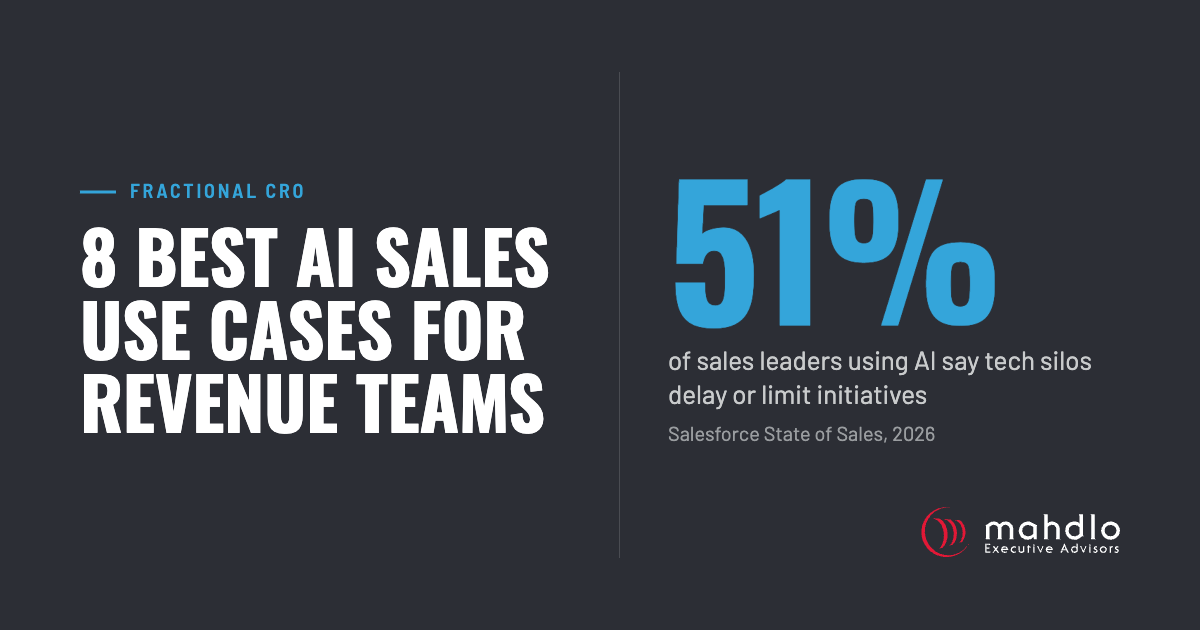
The constraint is usually data, not ambition. In its State of Sales report, Salesforce found that 51% of sales leaders using AI say tech silos delay or limit those initiatives. When CRM, marketing automation, support, and finance data sit in separate systems with separate definitions, the model inherits the disagreement. You get confident output built on partial facts, and your team stops trusting it.
So treat core-work adoption as an operating decision before it is a tool decision. Agree on one definition of an account, an opportunity stage, and a qualified lead. Decide who owns the data and who reviews what the AI produces. Then apply it where the work already happens, inside meeting prep, prioritization, pipeline inspection, and coaching, rather than beside it.
What Sales AI Means
Sales AI is software that uses machine learning, predictive models, or generative AI to analyze sales data, recommend actions, create or summarize content, and support decisions across the sales cycle. It is not an autonomous sales strategy. It is an execution layer around the strategy, process, data, and leadership discipline you already need.
Generative AI is especially useful for creating first drafts and summarizing unstructured information, such as call notes, account research, and proposal inputs. Predictive AI is better suited to scoring, forecasting, and pattern detection. Treating them as the same tool leads to weak implementation decisions.
The distinction matters because most companies are still bolting AI onto existing steps instead of changing the steps. McKinsey reports that only 21% of respondents reporting gen AI use say their organizations have fundamentally redesigned at least some workflows to use it. That is the gap between a tool that impresses in a demo and one that changes a number on your pipeline review.
So define the work before you define the tool. Decide which step in your sales cycle is slow or inconsistent, decide whether that step needs a draft or a score, then choose the technology that matches. That order keeps the decision in the hands of the people who own the number.
8 Best AI Sales Use Cases for Revenue Teams
1. Account research before a seller reaches out
AI can organize public company information, prior interactions, product usage signals, and account history into a concise pre-call brief. The seller starts with a stronger hypothesis about the buyer's priorities instead of spending 30 minutes gathering basic facts from disconnected systems.
The trade-off is accuracy. A brief should point the seller toward better questions, not become a script or a source of unverified claims. Build a review step for strategic accounts and define approved data sources before teams use AI-generated research in customer conversations.
2. Lead and account prioritization
Most teams have more possible targets than productive selling capacity. AI can rank accounts using fit, engagement, intent, stage progression, buying-group activity, and historical conversion patterns. That helps managers direct coverage toward opportunities with a credible reason to act now.
Use this when your CRM has consistent fields and enough history to reveal patterns. If definitions of a qualified opportunity vary by rep, fix the sales process first. AI will otherwise scale inconsistent judgment.
3. Faster, more relevant follow-up
After a customer call, AI can produce a draft recap, identify commitments, suggest follow-up language, and prepare a next-step email based on the discussion. This is one of the quickest ways to improve speed and consistency after meetings.
The best outcome is not simply more emails sent. It is a clear, buyer-specific next step with an owner and date. Require sellers to edit every external message. Generic language and incorrect details can damage credibility faster than delayed follow-up.
4. Call summaries and CRM hygiene
Incomplete CRM data reduces forecast confidence and forces managers to chase updates. AI can summarize conversations, surface objections, capture agreed actions, and propose CRM updates while the discussion is still fresh.
This use case works when it supports a defined inspection process. Decide which fields matter for opportunity quality, including business problem, stakeholders, decision process, next meeting, and competitive context. Then have the seller confirm the record. The system can reduce administrative burden, but the account owner remains responsible for the truth.
5. Deal-risk detection
A late-stage opportunity can look healthy in a forecast while key signals say otherwise: no executive engagement, no next meeting, declining activity, vague business case, or a single-threaded relationship. AI can flag these patterns across hundreds of deals before the weekly forecast call.
This gives sales leaders time to intervene with purpose. They can add an executive sponsor, strengthen the mutual action plan, identify missing stakeholders, or reset the forecast category. It also creates a more fact-based forecast culture. A risk signal is not a command to remove a deal. It is a prompt to inspect it.
6. Pipeline and forecast inspection
AI can help leaders summarize changes since the last review, identify stalled stages, compare rep-entered close dates against historical patterns, and prepare questions for forecast meetings. This is particularly valuable for PE-backed and scaling businesses where boards need a clear view of pipeline quality, not just a large top-line number.
Forecasting still depends on operating rigor. Standard stage definitions, exit criteria, and close-date rules must be in place. If the organization calls every early conversation a pipeline opportunity, no model can produce trustworthy confidence.
7. Coaching from real sales conversations
Managers often coach from anecdote because they cannot review enough calls to see recurring behavior. AI can identify themes across conversations, such as weak discovery, low talk-to-listen balance, missed questions about decision criteria, or inconsistent handling of pricing conversations.
Use the findings to improve one behavior at a time. A manager might review three calls with a seller, agree on a discovery objective, and assess progress in the next two weeks. Avoid using conversation analysis as surveillance. Explain what is analyzed, why it is used, and how it will improve seller capability.
8. Content and proposal preparation
AI can accelerate first drafts of outreach sequences, discovery agendas, account plans, proposal outlines, and internal deal reviews. It helps teams reuse approved messaging and subject-matter knowledge without starting from a blank page every time.
The word "first" matters. Marketing, sales leadership, and product experts must establish the messaging, proof points, and approval boundaries. AI can make the team faster, but it should not invent customer claims, pricing, legal terms, or technical commitments. Those areas require the appropriate internal review and, when needed, vetted specialists.
How to Choose the Right Use Case First
Prioritize by business constraint, not by tool features. If pipeline is thin, start with targeting, research, and seller follow-up. If pipeline exists but conversion is weak, focus on deal inspection, coaching, and next-step quality. If the board questions forecast reliability, begin with CRM discipline, stage definitions, and risk detection.
We recommend scoring each potential use case against four questions:
- Is the problem materially affecting revenue?
- Is there enough reliable data?
- Can a leader own the workflow?
- Can you measure a named outcome within 100 days?
Choosing badly is expensive. Across more than 1,200 Salesforce customers surveyed, the IBM Institute for Business Value found that only 33% of AI initiatives are meeting their ROI targets. The pattern we see is not bad technology. It is effort spread across use cases that were never tied to a constraint anyone in the business owned.
Useful measures include lead-to-meeting conversion, time to follow-up, CRM completion, stage-to-stage conversion, pipeline aging, forecast variance, and sales-cycle duration. Choose one primary measure for the initial rollout. A broad AI program with ten metrics usually produces little clarity.
Put Human Judgment and Governance in the Workflow
AI adoption succeeds when executives set practical boundaries. Define which data can enter the tool, who may access customer information, what requires human approval, and how output quality will be reviewed. The National Institute of Standards and Technology's AI Risk Management Framework offers a useful principle: govern AI risk as an ongoing management activity, not a one-time technology check. The cost of skipping that step shows up later. Gartner predicts at least 30% of generative AI projects will be abandoned after proof of concept by the end of 2025, because of poor data quality, inadequate risk controls, escalating costs or unclear business value.
Sales, marketing, operations, and leadership also need a shared operating model. Sales cannot use an AI-generated message that conflicts with brand positioning. Marketing cannot measure engagement without agreeing on what sales will treat as a qualified response. Revenue operations cannot improve forecasting when opportunity stages mean different things across teams.
At Mahdlo, we treat AI as a force multiplier inside a broader revenue engine. The work starts with the commercial priorities, process gaps, data readiness, and leadership cadence that determine whether a new capability creates measurable progress.
Pick one revenue constraint that your team can name without hesitation. Build the workflow around it, measure the result, and let your people use the recovered time to have better conversations with the buyers who matter most.
Related reading
Explore how Mahdlo Advisors combines strategy and execution to foster sustainable business growth. Discover tailored insights and innovative solutions.
See how we work →Where is your engine leaking?
Get a senior read in 30 minutes.
Not ready to talk? Get the sales prospecting guide →