

More ROI,
Less AI: Smart CMO's Are Prioritizing Outcome Over Output
AI made marketing output cheap and fast. Fractional CMO services that prioritize outcomes over outputs show where the next dollar should actually go.

Over the past few months, I've worked with a mid-market insurance broker, a consumer products manufacturer, and a PE portfolio company. Different industries but similar problems. Each has a small, sharp junior marketing team, armed with AI tools, and cranking out content and competitive intel at a blistering pace, yet no formal mechanism for deciding what content matters or measuring what it does.
An abundance of tactics is creating a shortage in judgement.
Experienced marketing leaders do not add more output to a team that already produces plenty. They install the judgement layer: deciding what gets built, what gets stopped, and how return is measured.
By the time you grab a second cup of coffee in the morning, a marketing specialist fresh out of college can produce a content calendar, competitive analysis, industry trend report, and a dozen campaign concepts complete with visuals and article drafts.
AI has collapsed the cost and increased the pace of production so significantly that our first instinct is, understandably, to call it progress. But faster production is not the same as better decisions.
Output and outcome are not the same
Volume has become a measure of success only because volume has become so easy to achieve. It makes marketing teams busier, but not necessarily more effective.
It often fails to solve for a critical piece of the puzzle. It doesn't matter how insightful your ideas are and how many thousands of people they reached, if they didn't get into the hands of the right people, at the right time, and in the manner in which those people prefer to consume it.
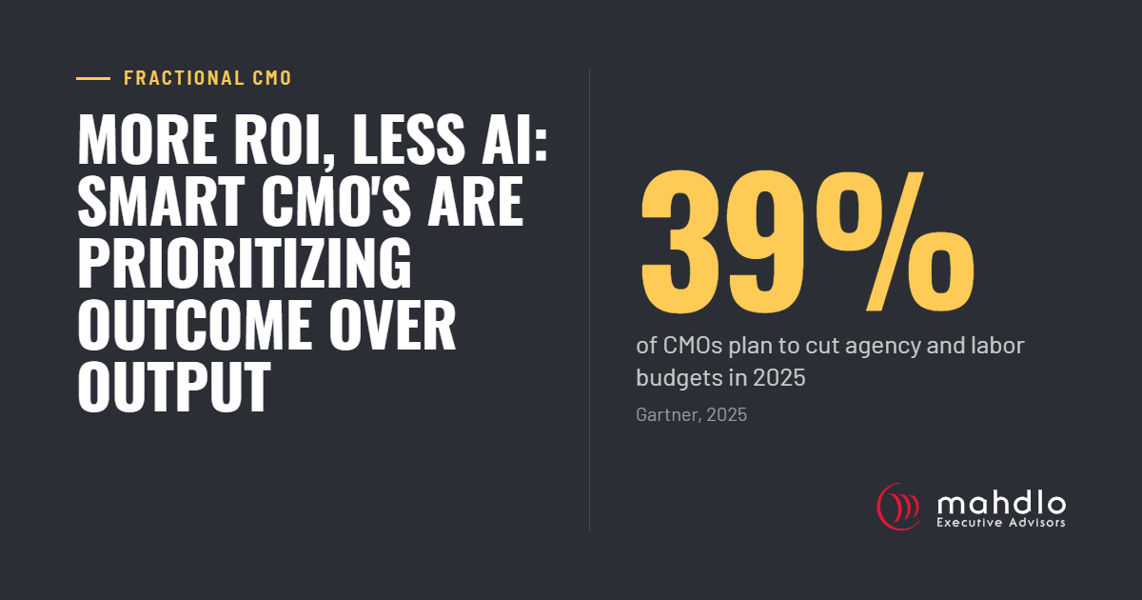
The pressure on budgets makes this worse. Gartner reports that as CMOs face flat budgets, 39% plan to cut agency spending and 39% plan to reduce labor spending, using AI-driven productivity gains to justify simplifying overlapping roles and headcount. When the money is flat and the output is cheap, volume becomes the easiest number to show. It is also the weakest proxy for return.
Increasing the pace of production is not wrong. What can be done quickly should be. Testing new tactics and learning is in the DNA of marketing and should never be abandoned.
But prioritizing the pace of output over the quality of outcome does come with real costs:
- Time. Flooding the market with content forces customers to choose what to pay attention to. The odds aren't in your favor.
- People. AI makes execution cheap, but managing it, from concept to creation to distribution to measurement, still requires an actual person (at least for now). And most businesses value headcount more than budget.
Reducing the flow of tactical busy work creates room for analysis, and that analysis will tell you where the next dollar should go.
Smarter pivots
The smarter pivot is usually a reallocation, not a cut. That distinction matters right now, because The CMO Survey reports that when profits fall short of expectations, 53.1% of company executives now choose to cut expenses rather than invest in revenue growth, up from 46% a year earlier, and marketing budgets get cut more often than other expense lines.
For an insurance broker chasing qualified leads, the answer was not more digital prospecting and outreach. Instead we focused on deepening ties with the accounting firms and wealth management partners with whom they already shared clients. That meant fewer campaigns, fewer assets, and a much shorter list of things the team had to keep alive each week.
One warm introduction, even at 10x the cost of a cold lead, almost always outperformed: higher conversion, shorter cycle, easier close. The math only looks strange until you price in the time the team stopped spending on prospecting that was not converting. Subtraction is not austerity.
It is a zero waste content strategy applied to the whole go-to-market plan, where every activity has to earn its place against the one thing you know works.
For a consumer products manufacturer we paused a sizable digital media spend to explore co-funded and co-branded options with their retail partners, which had not yet been fully considered.
An idea similar to this was buried in an old AI report that had been filed away. We saw its potential, understood how to integrate and position the investment into the product negotiation process, and secured tens of thousands in funding from multiple retail partners. We turned around and executed nearly the same campaign we initially designed, at twice the reach and half the cost.
The root cause
The analysis was not missing. The ability to see it and act on it was. That is a pattern worth noticing.
These tactical pivots did not come from a tool or system, or anyone named Claude. We pivoted our strategy after a root cause analysis revealed the true drivers of buyer behavior, as well as where in the sales cycle we could exert the most influence.
The answers, or options to consider, came from some very fundamental questions:
- What are the real growth goals, both short term and long term? Not the number in the deck. The number the business has to hit this year, and the position it needs to hold in three.
- How do customers actually buy? The path they take, the pace they move at, and who finally decides. In the insurance case, the decider was rarely the person filling out the form.
- Which levers change behavior, and which ones just add noise? Most plans carry both. Very few plans separate them.
Only after we drilled into these answers did the analysis earn its place. Then we began to explore CLTV equations, econometric modeling and financial attribution analysis, as well as look into dollars in / dollars out scenarios.
The order matters. Run the modeling before the questions and you get volume of a different kind, more data and less clarity, which is its own expensive habit.
Experience and execution are not mutually exclusive
The questions took an afternoon. The analysis and pivot took a week. The tactical execution took 60 to 90 days. Speed was never the constraint.
The discipline to ask the hard questions and identify the smartest, most efficient and measurable pathways forward, however, takes decades of first-hand experience. That part does not compress. You can shorten the build. You cannot shorten the judgement that decides what to build.
Today, when AI can produce something faster than it takes to even decide whether it is worth producing, this is exactly the depth of experience you want at the helm of your marketing and sales campaigns. The tools will keep getting faster. But the cost of pointing them at the wrong audience, the wrong offer or the wrong buyer keeps getting higher.
Seasoned marketing consultants and advisors know how and when to dig deeper to produce the best outcome. Not just an outcome.
Related reading
Where is your engine leaking?
Get a senior read in 30 minutes.
Not ready to talk? Get the go-to-market playbook →