

Business Transformation That Builds Revenue
Business transformation works when it changes how revenue is made. Here is how to find the commercial constraint, build the operating system, and prove it in 100 days.

McKinsey's How to Beat the Transformation Odds, by Boris Ewenstein, Wesley Smith, and Ashvin Sologar, found that 70% of transformations fail to meet their goals. That number matters when a board expects growth, a founder needs forecast confidence, or a leadership team has already invested in a new plan that has not changed commercial performance.
Business transformation is not a presentation, a reorganization, or a new technology purchase. It is the disciplined work of changing how your company makes decisions, reaches buyers, converts demand, and measures accountable revenue. The test is simple. Can your team execute a clearer growth model repeatedly, without depending on a few heroic people?
70% of transformations fail to meet goals
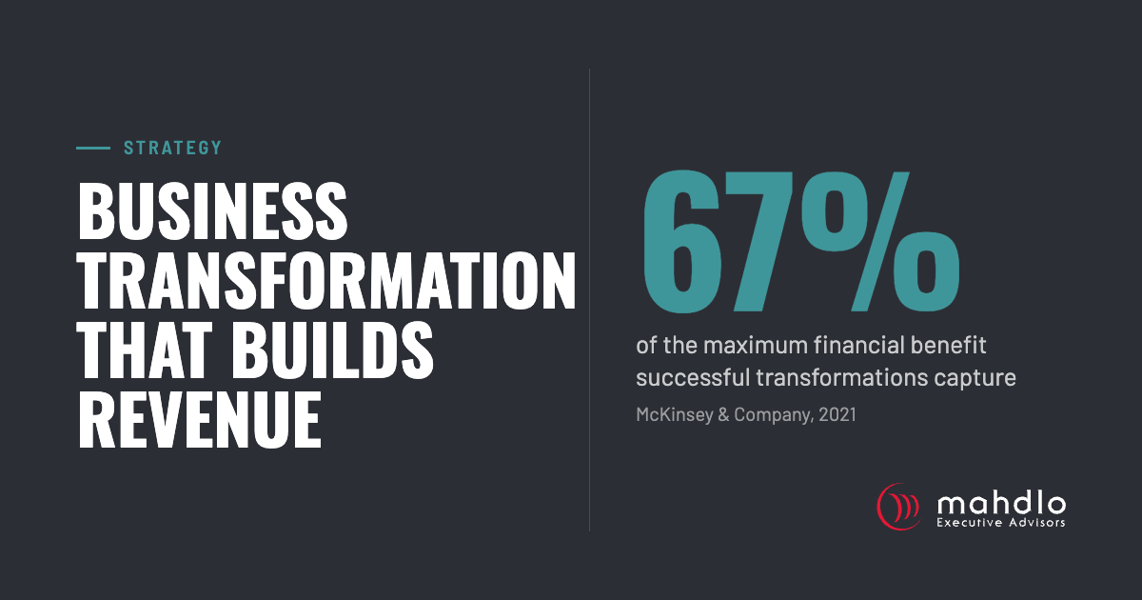
The McKinsey finding points to a familiar problem. Leaders often define the destination but underinvest in the operating system required to reach it. A strategy can be sound and still fail when sales, marketing, customer teams, data, and leadership priorities run on different assumptions. Even the transformations leadership rates as successful leave value on the table. McKinsey & Company found in 2021 that those companies capture 67% of the maximum financial benefit available to them on average, while other companies capture just 37%.
For a PE-backed or growth-stage business, the cost is not merely delay. Inconsistent pipeline, unclear conversion ownership, and weak forecasting can make it harder to demonstrate that growth is repeatable. For an established mid-market company, the same gaps can turn a manageable plateau into a longer cycle of missed plans and internal friction.
The answer is not to launch more initiatives. It is to make fewer commercial decisions with greater clarity, assign ownership, and establish a cadence that exposes what is working early enough to adjust.
What business transformation means in practice
Business transformation is a coordinated change to the capabilities that determine performance. For commercial growth, those capabilities usually include market focus, positioning, go-to-market design, sales process, demand generation, partner strategy, customer expansion, data visibility, and executive governance.
That definition separates transformation from improvement. Improving a campaign may produce more leads. Transforming demand generation means defining the ideal customer profile, sharpening the message, establishing qualification criteria, connecting marketing activity to sales stages, and giving leaders a shared view of pipeline quality. The named outcome is a repeatable demand engine, not a one-time spike.
It also separates transformation from disruption. You do not need to rebuild every process at once. Broad change programs often lose momentum because they ask the organization to absorb too much ambiguity. The right scope depends on the constraint. If win rates are weak, the first priority may be sales execution and value messaging. If the sales team lacks enough qualified opportunities, market focus and demand generation may come first.
Start with the commercial constraint
A transformation should begin with an evidence-based diagnosis, not a preferred solution. We look for the point where revenue momentum breaks: insufficient demand, poor qualification, low conversion, long sales cycles, limited retention, an underdeveloped channel, or a leadership gap that prevents decisions from becoming action.
This requires a shared baseline. Revenue leaders should be able to answer basic questions consistently: Which segments produce the best economics? Where does pipeline stall? What percentage of opportunities meet the agreed qualification standard? Which activities create opportunities that sales accepts? How accurate is the forecast by stage and period?
The objective is not perfect data before action. It is enough clarity to choose the first commercial problem to solve and establish a starting measure. If marketing reports lead volume while sales reports only closed revenue, neither team has the full picture. That gap shows up in the research. Gartner found in its B2B Commercial Strategy Survey that 90% of marketing and sales executives report their functional priorities conflict with one another. A common funnel definition creates one accountable conversation.
This is also where leadership teams need to confront trade-offs. Pursuing several buyer segments may expand the addressable market, but it can dilute messaging and slow the sales motion. Building a direct sales engine may create more control, while a channel strategy may create reach in markets where buyers expect trusted partners. There is no universal answer. There is only a choice that fits the buying process, deal economics, capabilities, and growth target.
Build a revenue operating system
A revenue operating system is the set of decisions, routines, measures, and roles that turn go-to-market strategy into daily execution. It is how sales and marketing stop debating symptoms and start managing the same commercial outcome.
First, define the growth thesis in operational terms. Name the priority segments, the buying problems you solve, the route to market, and the revenue motions that deserve investment. A company cannot meaningfully prioritize everything. The outcome is a focused go-to-market plan that teams can execute and leaders can evaluate.
Next, translate that plan into a stage-based revenue model. Set clear entry and exit criteria for each stage, identify the owner of each handoff, and decide which measures signal progress. Pipeline coverage alone is not enough if opportunity quality is inconsistent. A forecast is credible when teams use the same definitions, inspect deal movement at a regular cadence, and address risks before the end of the quarter. The model has to reflect how buyers actually transact. In a survey of B2B buyers, Gartner found 72% of transactions are completed through a sales rep-led channel versus 28% through a digital-led channel, so buyers move across channels in ways that require coordinated go-to-market execution.
Then create a practical decision rhythm. Weekly operating reviews should focus on leading indicators and blocked actions. Monthly reviews should test segment performance, conversion, capacity, and investment choices. Quarterly planning should reset priorities based on evidence, not habit. Meetings are not transformation by themselves, but a disciplined cadence makes accountability visible.
Finally, align enablement with the new motion. If you ask sellers to lead a more consultative conversation, they need clear discovery questions, proof points, objection paths, and manager coaching. If marketing is accountable for higher-quality demand, it needs feedback from sales on acceptance and conversion. Enablement is not a training event. It is the reinforcement that helps a new commercial model hold under pressure.
Use AI to accelerate execution, not replace judgment
AI can shorten the time between insight and action when it supports a defined commercial process. It can help teams summarize call themes, surface account research, draft first-pass outreach, identify gaps in CRM records, and make sales coaching more consistent. These are useful applications because they improve speed and focus around work your team already needs to do.
AI cannot decide your market position, repair a misaligned incentive structure, or create executive commitment. It also should not be deployed without clear guardrails for data, review, and ownership. The question is not whether AI belongs in the transformation. The question is where it removes administrative drag or improves decision quality without obscuring the human judgment buyers and teams rely on.
For many organizations, the best starting point is one workflow tied to a measurable commercial outcome. Improve opportunity qualification, reduce time spent preparing account plans, or give managers better visibility into coaching needs. Prove the workflow, document the process, and then expand deliberately.
Make the first 100 days visible
Transformation needs early proof, but quick wins should reinforce the longer-term model. A 100-day plan creates urgency when it moves through three overlapping phases: Plan, Activate, and Accelerate.
In the Plan phase, establish the baseline, identify the commercial constraint, make the critical choices, and assign accountable owners. In Activate, put the priority motion into market: clarify the message, tighten sales stages, launch the operating cadence, or activate the right partner route. In Accelerate, inspect results, remove blockers, and scale what the evidence supports.
The work does not end on day 100. The Sustain phase matters because new habits must become part of normal leadership management. This is where a fractional CMO or fractional CRO can add value beyond advice: providing executive revenue leadership, connecting marketing and sales decisions, and helping the internal team maintain momentum while the company builds durable capability.
At Mahdlo, we treat the 100-Day Accelerator as a way to convert ambition into an executable revenue roadmap. The goal is not activity for its own sake. It is a clearer commercial system, stronger accountability, and leadership confidence in the next decision.
Business transformation earns its value when people can see the change in how the company operates: sharper choices, cleaner handoffs, more reliable signals, and a revenue engine built to keep improving. Start where performance is constrained, make ownership explicit, and give your team a cadence that turns strategy into forward motion.
Related reading
Explore how Mahdlo Advisors combines strategy and execution to foster sustainable business growth. Discover tailored insights and innovative solutions.
See how we work →Where is your engine leaking?
Get a senior read in 30 minutes.
Not ready to talk? Get the go-to-market playbook →