

Channel Partners Versus Direct Sales for Growth
Channel partners versus direct sales: how mid-market revenue leaders decide which route to market owns the account, the forecast, and the customer experience.

McKinsey & Company's B2B Pulse 2024 reports that B2B buyers use an average of ten interaction channels during their buying journey. That changes the channel partners versus direct sales decision. Your buyers may expect direct access to your team, local expertise from a partner, and a coordinated experience across both.
Source: McKinsey & Company, B2B Pulse 2024.
For a CEO or revenue leader, this is not a philosophical choice between control and reach. It is a decision about where your company can create qualified demand, move complex deals forward, and retain customers with the highest confidence. The wrong model creates channel conflict, uneven forecasts, and a sales team chasing accounts it should never have owned. The right model expands coverage without diluting accountability.
Channel partners versus direct sales: the key finding
Direct sales means your employees own the customer relationship, from prospecting through close and, in some models, renewal. Your company controls the message, the sales process, customer data, pricing discipline, and account strategy.
Channel sales means an independent business helps sell, deliver, influence, or support your offer. That business may be a reseller, referral partner, distributor, systems integrator, technology partner, or managed service provider. A partner is not simply another lead source. It has its own priorities, margins, customer relationships, and sales capacity.
The key finding is simple: revenue coverage should follow buying friction. Use a direct motion where customers need deep discovery, executive alignment, custom commercial terms, or a high-trust relationship with your company. Use partners where they remove a real barrier to purchase, such as geographic reach, vertical credibility, implementation capability, or an established relationship with the buyer.
A channel is not automatically more scalable, and a direct team is not automatically more strategic. Both can fail when leadership treats the route to market as an organizational preference rather than a buyer-centered operating decision.
When direct sales is the stronger choice
Direct sales usually earns its place when the learning value of each customer conversation is high. If you are refining your ideal customer profile, pricing, product positioning, or onboarding model, your own team needs to hear objections and observe the buying process firsthand. Handing that work to partners too early can distance leadership from the market signals that shape a repeatable revenue engine.
A direct model is also stronger when the deal requires coordinated executive involvement. Enterprise sales often involve multiple business units, security reviews, procurement, and a commercial case tailored to the account. Your account executive can orchestrate internal specialists, maintain a single point of accountability, and preserve a clear record of decision makers and next steps.
Direct ownership matters most when these conditions apply: the sales cycle is complex, the offer is differentiated but hard to explain, account expansion is central to growth, or customer feedback must rapidly inform product and go-to-market decisions. The named outcome is control. You know who owns the forecast, what is blocking the deal, and whether the customer experience matches your promise.
That control carries a trade-off. You build coverage market by market and invest in manager capacity, sales enablement, pipeline discipline, and demand generation. A direct team without enough qualified opportunity becomes expensive activity rather than predictable growth. Before adding sellers, test whether your messaging, lead flow, conversion stages, and win-loss data support the capacity you plan to add.
When channel partners create more value
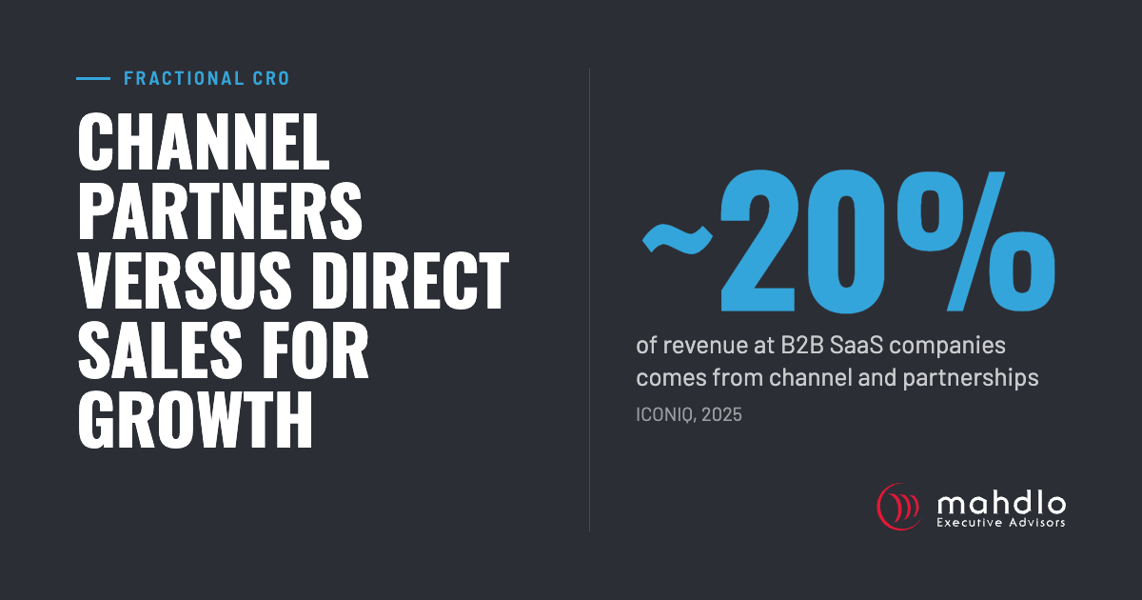
Channel partners become valuable when they bring an asset your company cannot quickly build on its own. In a new region, that asset may be local market knowledge and customer trust. In a specialized vertical, it may be a credible advisory relationship and familiarity with the customer's workflow. In a larger enterprise environment, it may be implementation capability that makes your solution easier to buy and adopt. The contribution is material at scale: ICONIQ's 2025 survey of 205 go-to-market executives found B2B SaaS companies derive an average of about 20% of total revenue from channel and partnership sales, rising to roughly 30% among companies above $250M ARR.
The named outcome is productive coverage, not a larger partner list. A partner program with 100 signed partners and five active sellers is not scaled distribution. It is an unmanaged database.
Look for evidence that a prospective partner can create revenue. Ask whether its sellers already call on your target buyers, whether your offer fits its current services, who will own enablement, and how both teams will identify and progress opportunities. A partner that cannot answer those questions clearly may still be a good relationship, but it is not ready to carry a revenue target.
Partner-led selling is especially useful when your buyers prefer to purchase through an existing provider, when implementation requires specialized services, or when international expansion requires market knowledge beyond your current team. It can also help a direct sales team enter accounts where the partner already has executive access.
The trade-off is reduced control. Partners sell competing offers, shift attention toward the easiest revenue, and may protect their customer relationship. You cannot solve that with a launch announcement or a commission plan alone. You need joint account rules, shared enablement, executive sponsorship, and a regular operating cadence.
Build a hybrid model around account ownership
Most growth-stage and mid-market companies need a hybrid model, and the way to make it work is to define account ownership before either team starts selling. The mistake is letting hybrid become ambiguous. When both your direct team and a partner believe they own an opportunity, the buyer sees friction and both sides lose trust. The scale of the question is real: Forrester reports that nearly 60% of B2B partner-ecosystem leaders say over 40% of their organization's revenue is attributable to partners and indirect routes to market.
Start with account ownership. Define which accounts are direct, partner-led, partner-influenced, and open for joint pursuit. Make the rules visible in your CRM, not buried in a partner agreement. Then define the handoff points. For example, your direct team may own strategy and commercial negotiations while a partner owns solution design or deployment. The customer should experience one coordinated plan.
Registration rules should reward early, verifiable partner engagement, not merely the first name entered into a system. Set a time-bound review process for disputes and assign one executive owner who can make a decision. The named outcome is speed. Deals cannot wait while teams debate credit.
Your compensation design must reinforce the behavior you want. Direct sellers need confidence that involving a qualified partner will improve their ability to win, not reduce their credit. Partners need confidence that bringing you into an account will not result in disintermediation. The precise mechanics vary by business model, but the principle does not: pay for customer progress and documented contribution.
Measure contribution, not just sourced pipeline
Pipeline sourced by partners is useful, but it is incomplete. A partner may influence a deal without creating the first meeting. Your direct team may originate an opportunity but depend on a partner's credibility, service capability, or market access to close it.
Track four measures across direct and partner routes: qualified pipeline created, win rate, sales-cycle length, and retention or expansion after the initial sale. These measures reveal whether a route to market produces durable revenue or only activity. Review them by segment, partner type, geography, and deal size. A broad average can hide the fact that one partner category works exceptionally well while another produces low-quality pipeline.
Also track partner activation. Activation means a partner has completed agreed enablement, identified target accounts, and progressed a real opportunity through defined stages. Signed agreements are an administrative metric. Activated partners are a commercial metric. Maturity shows up in the numbers: a survey of 454 partnership decision-makers by Forrester Consulting found 52% of companies get more than 20% of their revenue from the partnership channel, and high-maturity partner programs generate materially more partnership revenue than low-maturity ones.
AI can improve the discipline here. It can help summarize partner meetings, identify stalled opportunities, surface accounts with overlapping direct and partner activity, and prepare account plans from approved CRM data. It should not replace revenue leadership. A leader still has to decide which partners deserve investment, resolve conflicts, and hold both teams accountable for the buyer experience.
Choose the model your operating system can support
The decision often comes down to execution maturity. If your direct sales process is inconsistent, adding partners can multiply confusion. If your product is ready for broader reach but your team lacks geographic or vertical coverage, insisting on direct-only growth can delay momentum.
We recommend making the choice in a focused planning cycle. Confirm the target segments, map the buyer journey, define the role each route will play, and set a small number of measures that leadership reviews every month. In Mahdlo's 100-Day Accelerator, the Plan, Activate, and Accelerate phases overlap so revenue leaders can test the model while building the governance needed to sustain it.
Do not ask whether channel partners or direct sales is better in the abstract. Ask where your buyers need confidence, where your team has a right to win, and where a partner can make the path to revenue meaningfully stronger. That answer gives you a route to market your organization can execute with clarity.
Related reading
Explore how Mahdlo Advisors combines strategy and execution to foster sustainable business growth. Discover tailored insights and innovative solutions.
See how we work →Where is your engine leaking?
Get a senior read in 30 minutes.
Not ready to talk? Get the sales prospecting guide →