

Fractional CRO - Fixing the Hero Culture Before It Costs You
A fractional CRO replaces hero-dependent revenue with mapped process. What CEOs, boards and investors should do about key-person risk and toxic high performers.

You know the two or three names. One closes the complex deals. One keeps the biggest accounts calm. One knows why the forecast is really what it is. When any of them takes a vacation, has a bad month, or updates a profile on LinkedIn, you feel it in your chest before you see it in the numbers.
A fractional CRO is a part-time senior revenue leader who owns sales, marketing and the revenue process on your behalf, and one of the first things the role does is remove the company's dependency on individual people.
That dependency is the subject here. Not the people themselves, who are usually excellent, but the fact that the revenue motion lives in their heads and their relationships instead of in a system anyone can run.
If you are a CEO, board member or investor of/in a company between $10M and $100M, where one resignation can move a quarter, keep reading. This article covers what a Fractional CRO role does, why hero-dependent revenue gets priced as risk in diligence, and the practical sequence for building a revenue engine that survives any one person leaving it.
What a fractional CRO is, and what they own
A fractional CRO is a senior revenue leader who works with you part-time and owns the number: pipeline, forecast, and the system that produces both. The scope is the same as a full-time CRO. The commitment is a defined as finite scope of work, which is executive revenue leadership without the full-time overhead.
What sits inside that scope: pipeline coverage and quality, forecast accuracy, sales and marketing alignment down to a shared definition of a qualified lead, pricing and discount discipline, channel and partner revenue, and team enablement from onboarding through ramp. Then the routines that hold all of it together. The weekly forecast call, the pipeline review, the handoff criteria between marketing and sales, the deal desk. Routines are the product. Without them, the strategy lives in one person's judgment.
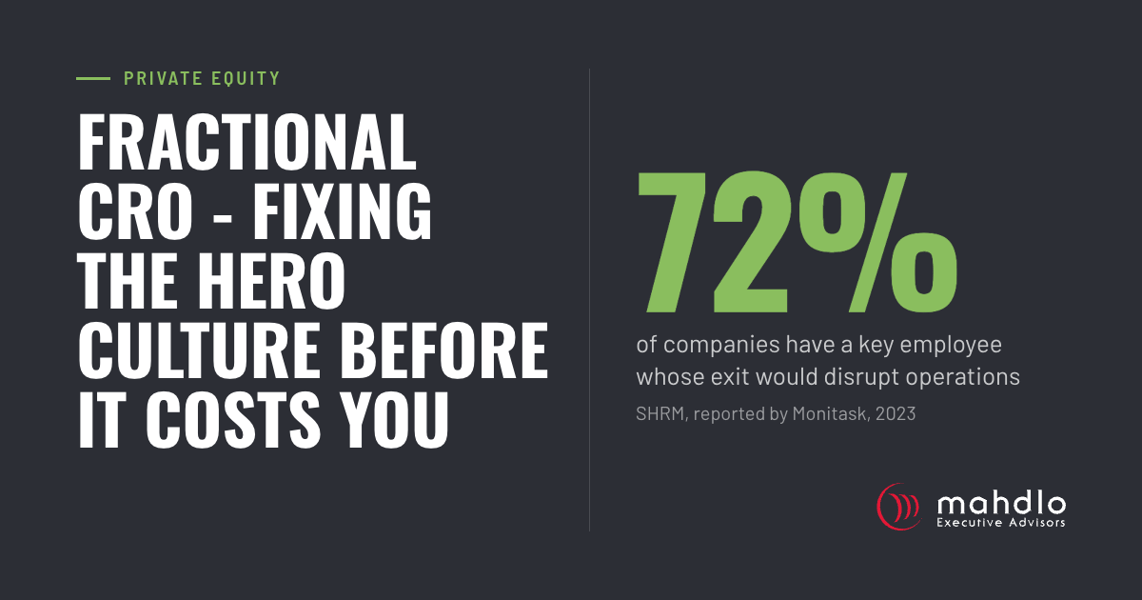
This is operating work, not a deck. The dependency problem it solves is widespread: a 2023 finding cited by SHRM reports that 72% of companies have at least one employee whose sudden departure would significantly disrupt operations. The ramp to $100M topline is filled with single-threaded risk. You can't afford to hire someone to take half the work that someone is already effectively managing, but are they is the real question.
Hero-dependent revenue is a risk the board should be pricing
Hero-dependent revenue looks like performance on a dashboard and reads as risk in diligence. The number is hit, so the board sees a healthy quarter. A buyer sees concentration, and concentration gets discounted. If one sales person accounts for 20% of your revenue and you don't have his/her process and pitch on paper, you are simply waiting to fail.
How do you spot a hero culture? Four exposures show up every time. Deals that closed on one person's relationships and cannot be repeated by anyone else, so the growth model is unproven at the next revenue level. The forecast lives in that person's head, which is why accuracy swings when they are out. There is no second line of succession, so a resignation becomes a two to three quarter rebuild rather than a handover. And at exit, revenue that depends on named individuals invites a valuation adjustment or an earnout structure that keeps the founder on the hook.
None of this is visible in a pipeline report. It becomes visible when a buyer's diligence team asks who sourced each of your top ten accounts and what happens if that person leaves. Price the risk before someone else does.
How work gets done matters as much as what gets done
Judge the method, not just the number on the board. A seller who hits quota while bulldozing process, hoarding accounts and burning through SDRs is extracting value from the system faster than they add it, and the extraction shows up two or three quarters later in ramp time, pipeline quality and attrition.
The cost is measurable. Cornerstone OnDemand found that good employees are 54% more likely to quit when they work alongside a toxic employee, once the proportion of toxic staff on a team reaches as little as a 1-in-20 ratio. In a 20-person commercial team, that is one person.
This is not an argument for removing high performers. Most of them are coachable, and the behavior usually persists because nobody has named it as a standard. So name it. Write down how a deal is qualified, how an account is transferred, how a handoff is documented. Then hold the top producer to the same standard as the new hire, and measure both on how they work as well as what they close.
One toxic operator can take the culture with them
In a company of 200 people, one toxic operator sets the standard for everyone who watches them get away with it. And not only get away with it, but are financially rewarded for doing it. The quiet message to the rest of the team is that the rules bend for revenue, and good people read that message quickly. You might say, they can produce revenue too and if they did, they too would be rewarded. Don't discount how wide the toxin spreads; product managers, procurement, SDRs, operations/fulfillment and marketing managers are typically on a different incentive plan. So, if they don't like what they see, you will experience attrition there.
The research is blunt about what that costs. An analysis of MIT Sloan Management Review's research on 34 million employee profiles and 1.4 million Glassdoor reviews found that a toxic corporate culture was 10.4 times more predictive of a company's industry-adjusted attrition rate than compensation, which ranked only 16th among 172 factors studied. You cannot pay your way out of a culture problem.
In a sales organization, attrition is not a people cost alone. It is a revenue cost. Every departure resets ramp time, breaks continuity on named accounts, and strands the pipeline with a rep who no longer works here. You usually see it two quarters later, in coverage that thinned out while nobody was watching the leading indicator.
Mapping the process so no single person is the process
You remove hero dependency by writing the revenue motion down and giving every stage an owner, a routine and a system of record. It is five steps, and they run in order.
- Map the revenue motion end to end, from first touch to renewal, in stages your team already recognizes.
- Name the owner of each stage and the input every other stakeholder provides. One owner, explicit contributors, no shared accountability.
- Write the routines: forecast call agenda, weekly pipeline review, handoff criteria between marketing and sales, and what qualifies a deal to advance.
- Instrument the system so the data lives in the CRM rather than in someone's head or notebook. If it is not recorded, it does not exist.
- Pressure-test it. Pull one person out of an active cycle for two weeks and see what stalls.
Expect the first durable change in 60 to 90 days. That is a range, not a promise, and it depends on how much of your current process is already written down. But, do not expect to see revenue growth in that window, this was only the change to facilitate growth.
Where AI helps here, and where it does not
AI is useful in this work for four specific jobs: capturing what was said on sales calls, keeping CRM records current without relying on rep discipline (which we all know is simply not happening), inspecting pipeline for stalled or single-threaded deals, and flagging accounts where one relationship carries the whole opportunity. Those are exactly the places where hero dependency hides, and they are the places where machines beat memory.
What AI does not do is set the standard. It will not tell you that a top producer is burning through the SDR team. It will not hold the conversation with that person. It will not decide who leads the region next year, or who is ready for a second line of succession.
Used well, call capture and automated CRM updates return several hours a week per seller to selling, which is time added to the system rather than headcount taken out of it. The tools surface the pattern. A revenue leader reads it, names it, and acts on it with your team in the room.
Signals it is time to bring in a fractional CRO
Bring in a fractional CRO when the revenue system depends on people rather than process, and the pattern is visible in your own numbers. Five signals are worth checking this quarter.
Forecast accuracy swings more than 20 percent quarter to quarter. Two people touch most of what closes. New sellers take longer than two full quarters to produce at quota. Sales and marketing describe a qualified lead differently when you ask them separately. Your strongest people are leaving and the exit interviews start to rhyme, or worse, they start to say nothing at all.
Mahdlo's work starts with the revenue motion as it actually runs, not as the org chart describes it. The 100-Day Accelerator moves through Plan, Activate and Accelerate as overlapping phases, with measurable results in 100 days: owners named at every stage, routines written down, pipeline data in the CRM, and a second line of succession where there was one name. After day 100 the focus shifts to scale.
This week, pull the last 12 months of closed revenue and mark every deal that would not have closed without one named individual. The percentage is your starting point.
Related reading
Explore insightful strategies for business growth through expert insights from Jim Tax, covering marketing, operational planning, and success stories.
See how we work →Where is your engine leaking?
Get a senior read in 30 minutes.
Not ready to talk? Get the go-to-market playbook →