

Fractional CRO Versus Sales Consultant Compared
Fractional CRO versus sales consultant: one advises on a sales problem, the other owns the revenue system. How to tell which your company needs now.

McKinsey Global Institute puts the annual economic potential of generative AI across business use cases at $2.6 trillion to $4.4 trillion. That potential will not fix an unclear commercial strategy, an unreliable forecast, or a sales team without accountable leadership. The decision between a fractional CRO versus sales consultant comes down to a more practical question: do you need someone to advise on a sales problem, or an executive to own the revenue system behind it?
For a PE-backed company, a Series B or C business, or a mid-market firm facing a growth plateau, that distinction affects speed, accountability, and board confidence. Both models can create value. They solve different problems.
Fractional CRO versus sales consultant: the key difference
A sales consultant is typically engaged to diagnose, recommend, teach, or improve a defined part of the sales function. The assignment may focus on sales process, compensation design, pipeline discipline, CRM adoption, account strategy, enablement, or a specific capability gap. Their central deliverable is expertise applied to an agreed problem.
A fractional Chief Revenue Officer is a part-time executive leader who takes responsibility for building and guiding the commercial operating system. That usually includes revenue strategy, go-to-market priorities, sales and marketing alignment, forecasting, team operating cadence, channel strategy, and executive decision-making. Their role is not simply to produce a plan. It is to lead the work needed to make the plan operate.
The difference is accountability. A consultant can tell you what must change. A fractional CRO helps your leadership team decide what matters first, establish who owns each outcome, and keep the organization moving when execution gets difficult.
This is especially relevant when growth has become a cross-functional issue. A pipeline problem may be caused by weak demand generation, unclear positioning, poor qualification, inconsistent follow-up, pricing friction, a missing channel strategy, or all of them at once. Harvard Business Review estimates that sales and marketing misalignment costs businesses more than $1 trillion each year in lost productivity and wasted effort. Treating that as a sales-only problem can create activity without improving forecast confidence.
The research finding: AI value depends on operating change
AI value depends on operating change. McKinsey Global Institute reaches its estimate in The Economic Potential of Generative AI: The Next Productivity Frontier, by Michael Chui, Eric Hazan, Roger Roberts, Alex Singla, Kate Smaje, and colleagues. The report identifies sales and marketing among the business functions with significant potential for value creation.
For executive teams, the practical lesson is straightforward. AI accelerates a defined process. It does not define the market, choose the ideal customer profile, repair a weak handoff between marketing and sales, or create leadership accountability.
A sales consultant may help select and train a team on AI-enabled sales workflows. A fractional CRO determines where those workflows belong in the revenue model, establishes adoption expectations, and measures whether they improve pipeline quality, sales-cycle velocity, or forecast reliability. The technology is a force multiplier. The leadership model determines whether it produces a measurable outcome.
When a sales consultant is the better fit
A sales consultant is often the right choice when your company has capable revenue leadership and a contained problem with a clear owner. You may have a strong VP of Sales who needs an outside perspective on enterprise deal strategy. Your sales process may be sound, but qualification standards are inconsistent. Or your team may need a focused reset around discovery, account planning, sales management, or CRM discipline.
In these cases, the objective can be specific and time-bound. Define the problem, agree on the expected behavior change, assign an internal executive sponsor, and determine how success will be measured. A consultant can bring useful pattern recognition without displacing the leaders already accountable for the broader commercial agenda.
This approach works best when marketing, sales, and finance already agree on core definitions. If everyone uses the same standards for a qualified opportunity, pipeline coverage, stage progression, and revenue forecast, a focused sales intervention can improve performance quickly.
The trade-off is that recommendations require internal leadership to carry them forward. If your CEO is already acting as the de facto CRO, or the sales leader lacks the authority to align marketing and operations, a well-designed consulting engagement can still stall after the presentation phase.
When you need a fractional CRO
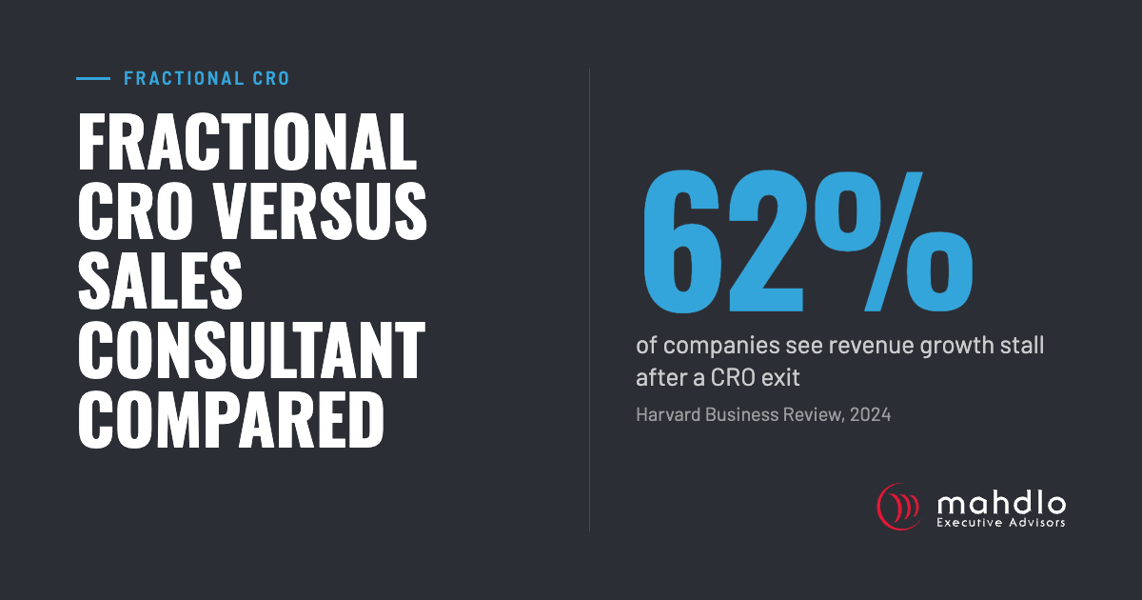
A fractional CRO is better suited to a leadership gap or a revenue system that needs to be rebuilt while business continues to move. This is common after a funding event, a private equity transaction, a new-market push, an acquisition, a strategic pivot, or a period of missed forecast expectations. The cost of leaving that seat empty or filling it badly is measurable. Harvard Business Review, citing SBI Growth research, reports that 62% of companies see their revenue growth rate decline or stay flat in the fiscal year following a chief revenue officer turnover.
You likely need fractional revenue leadership if your executive team is debating basic commercial questions without a clear answer. Which segments deserve focus? Is the issue volume, conversion, sales capacity, or retention? What should marketing be accountable for? Which opportunities belong in the forecast? Which channel partners can produce repeatable revenue rather than one-off introductions?
A fractional CRO brings these questions into one operating model. That means setting revenue priorities, clarifying the go-to-market narrative, creating a decision cadence, and ensuring sales and marketing work from the same commercial assumptions. The work is strategic, but it must show up in weekly behavior: pipeline reviews, campaign-to-opportunity handoffs, deal inspection, leadership meetings, and forecast updates.
For boards and investors, this model can create a clearer view of the path from strategy to execution. The value is not another dashboard. It is a leadership structure that makes the numbers more credible because the inputs, definitions, and accountability are visible.
Compare the roles by the decision you need to make
The cleanest way to choose is to start with the business decision, not the job title.
If you need to improve a defined sales motion, a consultant may be enough. Examples include refining discovery standards, improving enterprise pursuit strategy, redesigning sales stages, or helping managers coach more consistently. Your internal leadership team still owns the complete revenue engine.
If you need to decide where the company will compete, how marketing and sales will work together, what the forecast means, and which investments should come first, you need executive revenue leadership. A fractional CRO can lead that system while strengthening the leaders who will sustain it.
If you are entering an international market or developing channel partner revenue, the distinction becomes even more important. Those initiatives cut across positioning, market selection, partner economics, demand creation, selling motion, operations, and governance. A consultant may advise on one workstream. A fractional CRO can coordinate the full commercial decision set, with specialized work supported by vetted partners where needed.
What to expect in the first 100 days
The first 100 days should produce clarity and momentum, not a long diagnostic followed by a delayed plan. At Mahdlo, our 100-Day Accelerator runs Plan, Activate, and Accelerate as overlapping phases, then shifts to Sustain after day 100.
In the planning phase, leadership aligns on the commercial baseline: revenue goals, target segments, pipeline quality, conversion points, sales capacity, current demand generation, and the assumptions behind the forecast. This is where we separate symptoms from constraints. A low pipeline number, for example, may reflect weak market focus, poor conversion, or a sales capacity issue. Each requires a different response.
Activation puts the highest-priority changes into motion. That can include a tighter ideal customer profile, clearer qualification criteria, a revised opportunity review, a sales and marketing service-level agreement, or AI-supported workflows that reduce administrative friction and improve follow-up quality.
Acceleration measures whether those changes are improving the revenue engine. The executive team should see a practical operating rhythm, defined owners, and measurable leading indicators. After day 100, the goal is not dependence on outside advice. It is a sustainable cadence your team can run with confidence.
Questions to ask before you choose
Ask whether the engagement requires someone to recommend change or to lead change. Then ask who inside your company has the authority, capacity, and commercial perspective to carry the work across sales, marketing, finance, and operations.
You should also ask how progress will be measured. A credible answer names the operating metrics that matter to your stage of growth: pipeline coverage, conversion between stages, sales-cycle length, win rate, forecast accuracy, source quality, partner-sourced opportunities, or retention expansion. The right measures depend on your model, but they must connect to a revenue decision.
Finally, ask what remains after the engagement. A strong consultant should leave your team with a usable improvement plan. A strong fractional CRO should leave you with something broader: aligned leadership, a repeatable operating cadence, clearer commercial decisions, and a scalable revenue roadmap.
The right choice is not about hiring more advice or adding another executive title. It is about giving your company the level of leadership required to turn growth ambition into an operating reality, and giving your team a clear next move.
Related reading
Explore how Mahdlo Advisors combines strategy and execution to foster sustainable business growth. Discover tailored insights and innovative solutions.
See how we work →Where is your engine leaking?
Get a senior read in 30 minutes.
Not ready to talk? Get the sales prospecting guide →