

International Expansion Strategy Guide for CEOs
An international expansion strategy guide for mid-market CEOs: how to select markets, prove demand, pick a route to market, and know when to scale or exit.

UN Trade and Development reports that global foreign direct investment fell 2% to $1.3 trillion in 2023 in its World Investment Report 2024. That volatility is why an international expansion strategy guide must begin with evidence, not ambition. A new country can diversify revenue and increase enterprise value. It can also drain leadership attention, extend sales cycles, and expose gaps in your go-to-market model.
For a US-based company, international expansion is not the act of selling abroad. It is the deliberate process of proving repeatable demand in a new market, establishing a viable route to market, and building the operating discipline to scale without distracting the core business. The right move is rarely to launch everywhere. It is to make one market work well enough that the next decision becomes clearer.
The key finding: market selection determines expansion risk
Market selection is the single decision that sets the risk profile of the whole program. The biggest early mistake is choosing a country because it has a large total addressable market, a familiar language, or an executive connection. Those factors may help, but they do not prove that you can acquire, serve, and retain customers at an acceptable cost.
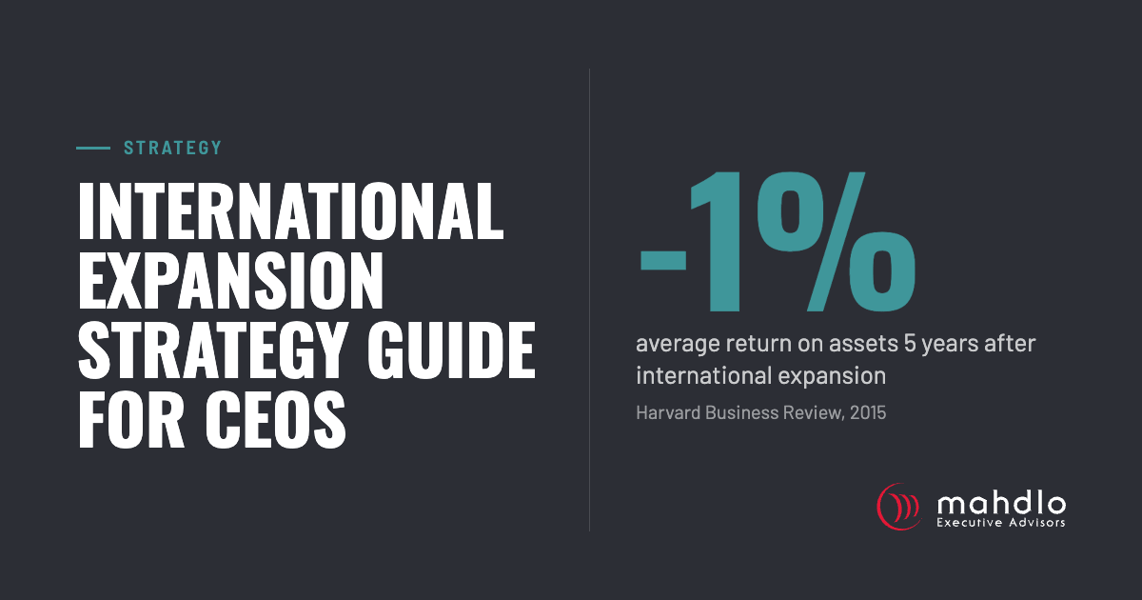
The cost of getting this wrong is measured in years, not quarters. Harvard Business Review found that companies expanding internationally post an average Return on Assets of roughly -1% even five years after entering a new market, that it takes about ten years before that return turns modestly positive, and that only 40% of firms ever exceed a 3% return. Selection discipline is what separates the market you can make work from the one that quietly absorbs capital and attention.
A strong market-selection decision compares opportunity against execution friction. We look at the customer problem, willingness to pay, buying process, competitive alternatives, local channel access, implementation needs, and the time required to create a qualified pipeline. A market with fewer prospects but faster access to the right buyers can be more valuable than a larger market where your sales motion does not translate.
Start by defining the outcome the expansion must produce. It may be revenue diversification, access to a strategic customer segment, partner-led growth, or a foothold that supports enterprise accounts with international operations. The outcome sets the threshold for investment and prevents a promising experiment from becoming an open-ended initiative.
You also need an explicit no-go decision. If your leadership team cannot state what evidence would cause it to pause or exit the market, it is not managing a test. It is managing hope.
Build your international expansion strategy around proof
An international expansion strategy should answer four questions before you add significant commercial capacity: Is the problem urgent in this market? Can we reach buyers through a repeatable route? Will the economics support the model? Can we deliver the customer experience our brand promises?
Validate demand before forecasting revenue
Begin with a focused set of customer and partner conversations in each priority market. The goal is not polite feedback. It is to identify whether the buyer recognizes the problem, how they solve it today, who approves the purchase, what slows the deal, and whether your value proposition earns attention without extensive explanation.
Translate those findings into a local market hypothesis. Specify the ideal customer profile, priority use case, buyer roles, expected sales cycle, price range, likely objections, and the proof required to advance an opportunity. Your hypothesis should be clear enough for sales, marketing, product, and finance leaders to challenge.
Do not mistake website traffic or event interest for market validation. Evidence becomes meaningful when buyers agree to a substantive next step: a discovery process with the economic buyer, a pilot with defined success criteria, a partner commitment, or a qualified opportunity tied to a real timeline.
AI can speed this work by organizing account research, identifying common language in buyer interviews, and surfacing patterns in call notes. It cannot determine product-market fit on its own. Executive judgment is still required to separate a real signal from a loud but unprofitable request.
Choose the route to market that fits the buyer
Your US sales motion may not travel well. In some markets, buyers expect direct engagement from a local commercial leader. In others, trusted distributors, referral partners, systems integrators, or strategic alliances provide the credibility and access a new entrant lacks.
A direct model gives you closer control of messaging, customer feedback, and margin. It also requires more local market knowledge, management capacity, and time to establish trust. A channel-led model can create faster coverage and reduce the burden on your internal team, but only when partner incentives, enablement, and deal ownership are clear.
Avoid signing a broad group of partners before you have proven the partner profile. Start with a small number of organizations that already serve your target buyers and can explain where your offer fits within their existing portfolio. Define the joint value proposition, qualification rules, sales stages, forecast expectations, training plan, and accountability for pipeline creation.
Channel revenue is not created by a partner announcement. It is created when a partner can identify the right customer, articulate the business case, and move an opportunity through a shared process.
Localize what affects the buying decision
Localization is more than currency conversion and regional spelling. It is the adaptation of your message, proof, commercial process, and delivery model to the realities of the market.
Some elements should remain consistent. Your core positioning, qualification discipline, customer value, and brand standards need continuity. Other elements may require change: customer examples, buyer language, procurement expectations, contract workflow, partner materials, implementation support, and the order in which benefits are presented.
This is where many leadership teams overcorrect. Full localization before demand is proven creates delay and fixed cost. No localization creates avoidable friction. The practical approach is to localize the assets and processes that directly affect qualified opportunities, then expand investment as the evidence strengthens.
Legal, tax, employment, privacy, and regulatory requirements vary by market and industry. Those decisions require qualified legal, tax, and compliance professionals. A Mahdlo-led expansion effort can coordinate vetted specialists within the commercial plan, while keeping leadership focused on market choices, revenue milestones, and execution accountability.
Run expansion as a measured operating program
International expansion fails when it sits outside the normal revenue operating rhythm. Treat it as a managed growth program with a single executive owner, a cross-functional decision team, and a scorecard that distinguishes activity from progress. The discipline matters because few companies start with the capability. In a joint IMD/BCG Global Readiness Survey of 362 executives, only 10% of companies believe they have the full set of capabilities needed to win overseas, and midsize companies are described as particularly vulnerable because they are less nimble than smaller competitors but lack the scale and systems of larger ones.
The scorecard should track leading and lagging indicators. Leading indicators include target-account coverage, buyer meetings, partner-sourced introductions, qualified pipeline, conversion by sales stage, and time to next step. Lagging indicators include bookings, revenue, gross margin, retention, and expansion within accounts.
Do not use a single pipeline number as proof of success. A pipeline can look healthy while opportunities stall because the wrong buyer was targeted or the local business case is weak. Review deal quality, stage aging, source effectiveness, and forecast confidence every month.
A 100-day plan creates the urgency this work needs. In the first phase, define the market thesis, prioritize segments, assess the route to market, and establish baseline measures. Next, activate the commercial motion through targeted outreach, buyer discovery, partner engagement, and localized sales enablement. Then accelerate what is working by refining qualification, improving conversion points, and increasing support behind the most credible market signals.
The phases overlap by design. You should not wait for a perfect plan before learning from the market, and you should not scale activity before the evidence supports it.
Know when to scale, pause, or exit
The expansion decision after the initial test should be disciplined. Scale when you see repeatable buyer interest in a defined segment, a route to market that produces qualified opportunities, and economics that can support growth. Pause when demand exists but your sales motion, packaging, or delivery model needs revision. Exit when the evidence shows that the market cannot meet the agreed threshold within a reasonable operating window.
This is not failure. It is capital allocation. A timely no allows your team to focus on markets and motions where it can create durable value.
For PE-backed and growth-stage companies, that discipline also improves board communication. Instead of reporting that the company is "pursuing international growth," you can show the market thesis, evidence collected, risks identified, decisions made, and next milestone. That creates forecast confidence and makes the resources behind expansion easier to defend.
International growth rewards leadership teams that combine ambition with operational restraint. Choose a market for the strength of the evidence, build a route to market buyers will trust, and let measurable learning guide every next commitment. The result is not simply a presence in another country. It is a revenue engine you can govern with confidence.
Related reading
Explore how Mahdlo Advisors combines strategy and execution to foster sustainable business growth. Discover tailored insights and innovative solutions.
See how we work →Where is your engine leaking?
Get a senior read in 30 minutes.
Not ready to talk? Get the go-to-market playbook →