

Is It Me or Is It the Team? A Founder's Honest Audit
Is it me or is it the team? If you have churned two CMOs in 18 months, the vision may be the problem. How founders test clarity before replacing leaders.


The resignation letter is on your desk for the second time in 18 months. Same seat. Same explanation, delivered politely: they did not quite get it here. You hired carefully both times. You checked references. And now you are sitting with the question every founder eventually asks in private, usually late at night. Is it me or is it the team?
When two revenue leaders exit the same seat inside two years, the cause is almost never a run of bad hires. It is a vision that was never translated into a sellable value proposition and an operating plan the leader could actually run.
That is a harder answer than a hiring mistake, because it points back at you. It is also a better one, because a brief can be fixed in weeks. A pattern of turnover cannot be fixed by hiring a third time.
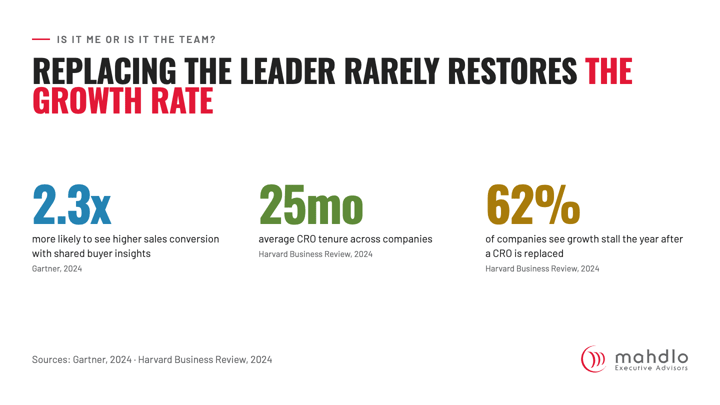
Repeated revenue leader turnover is usually a clarity problem, not a talent problem
Two or more exits in the same seat inside 24 months is a signal about the brief, not the people. Replacing the leader rarely moves the number: Harvard Business Review reports that 62% of companies see their revenue growth rate decline or stay flat in the fiscal year after replacing their chief revenue officer.
The pattern underneath that figure is consistent. A new CRO or CMO spends the first quarter interpreting what you meant rather than building against what you wrote. They interview your team, read the deck, infer the priorities, and place a bet on which version of the vision is the real one.
Then the clock runs out. By the time the guess is tested in a full sales cycle, month nine has arrived and the board wants proof. The leader leaves, the search restarts, and the next one begins the same quarter of guessing. Three hires in, you have purchased the same first 90 days three times.
A founder's real job is to set the vision and make it executable
Your job is to paint the picture, communicate it until the team can repeat it without you in the room, and then step out of the execution lane. Senior revenue leaders do not need you to approve the plays. They need a written mandate, a defined number, and the authority to own it.
Stable tenure is normal where that mandate is clear.
What happens instead is quieter and more costly. When you stay in every decision, your existing talent learns their judgment is provisional. Senior candidates read it in the interview within twenty minutes. The company becomes single-threaded through you, and every decision moves at the speed of your calendar.
Paint the picture, then ask your team to explain it back in their own words
Here is the cheapest diagnostic you can run this week. State your vision once, in a single meeting, then ask each of your top five leaders to write one paragraph: what this means for my function, and what I will stop doing because of it. Give them 48 hours. Read the five paragraphs side by side.
The answers tell you where you actually stand.
- Five different versions of the vision means the picture was never painted. The gap is yours to close, not theirs.
- Five near-identical restatements of your own words means they are quoting you, not understanding you. Nobody has translated it into their world.
- Silence on what to stop means no priorities were set. A vision that adds work without removing any is a wish list.
Converting a vision into a sellable value proposition
A vision becomes operational only when it is restated as something a buyer will pay for. Until then it is a belief, and no revenue leader can build on a belief.
The translation runs in five parts, in order. Who the buyer is, named specifically enough that your team can list twenty of them. What changes for that buyer when they work with you. Why you and not the alternative they are already using. What the change is worth in their terms. What proof you can put in front of them today.
A CMO cannot build demand generation on an aspiration. A CRO cannot build a comp plan or a forecast on one. Both will try, quietly, for a quarter, which is part of why SaaStr finds CMOs and CROs average just 1.8 years in role with 32% annual turnover.
This is the handoff most founders skip.
Slow to hire, quick to fire is the wrong setting for revenue leadership
Reverse the instinct. Hire deliberately, then be slow to fire, because the 1.8 year average tenure in revenue leadership seats is mostly made of people who were judged before their work could show up in a number.
Deliberate hiring means a written mandate and a defined number before the first interview. What the leader owns, what they can decide alone, what the pipeline and revenue targets are by quarter, and what support they get. Then give them two full sales cycles. If your cycle is four months, that is eight months before you draw a conclusion.
Trust is the variable here. If you cannot let a leader own the number for two quarters without overriding them, the role is not real. You are hiring a deputy and paying for an executive.
Five signs the problem is the brief and not the hire
Five signals tell you the mandate is broken rather than the person. Check them this week; each one is observable without a survey or an outside assessment.
One, more than one exit in the same seat in 24 months. Two, no written value proposition your sales team can repeat back without opening a deck. Three, the leader's first 90 days spent interpreting what you meant instead of building pipeline. Four, decisions routing back to you after the role was handed over. Five, your last three senior hires describing the strategy differently from each other.
One signal is noise. Three or more and the next hire fails for the same reason the last two did. Fix the brief before you open the search.
How Mahdlo works on this
We write the mandate and the value proposition with you before anyone is hired. Our advisors have run revenue organizations, so the work starts where the failure starts: naming the buyer, the change they are paying for, the proof, and the number the seat owns. Then one of us stands in the seat as Fractional CMO or Fractional CRO while the plan is proven, which is executive revenue leadership without the full-time overhead. The 100-Day Accelerator runs Plan, Activate and Accelerate as three overlapping phases with measurable results in 100 days, testing the picture you painted against real pipeline before you commit to a permanent hire.
This week, write your value proposition in five sentences. Send it to your top five leaders. Ask each one to return what they would stop doing because of it.
Related reading
Explore insightful strategies for business growth through expert insights from Jim Tax, covering marketing, operational planning, and success stories.
See how we work →Where is your engine leaking?
Get a senior read in 30 minutes.
Not ready to talk? Get the sales prospecting guide →