

Post Acquisition Marketing Integration: The First 100 Days
Post acquisition marketing integration decides whether combined pipeline compounds or collapses. A sequenced 100-day plan, brand architecture calls, and sponsor metrics.

The deal closed six weeks ago. The combined forecast is a spreadsheet nobody trusts, because the two companies define a qualified opportunity differently. Both demand gen teams are bidding on the same keywords, raising your own cost per click. Your sponsor wants a synergy number by the next board meeting, and the honest answer is that you cannot produce one yet.
Post acquisition marketing integration is the work of merging brand, demand generation, data and revenue reporting into one commercial engine, and it is a revenue event, not a back-office cleanup.
That distinction decides how the next 100 days go. Treated as a systems migration, integration gets handed to a project manager, finishes on schedule, and delivers no pipeline. Treated as a revenue event, it is owned by someone who reads a pipeline weekly, protects the demand already in flight, and gets one number everyone trusts before the brand decision is ever made.
What breaks in the first 90 days after a bolt-on
Five things break, and they break in roughly the same order every time. Duplicate demand gen spend starts bidding against itself on shared keywords, raising your own cost per click. Two brands show up in the same buyer's inbox with different promises. Two CRMs carry stage definitions that do not reconcile, so a Stage 3 in one system is a Stage 1 in the other. Two pipeline definitions then produce a forecast blackout, which is the moment the sponsor stops asking about synergy and starts asking about control. And senior marketing attention turns inward, away from the market and toward who reports to whom.
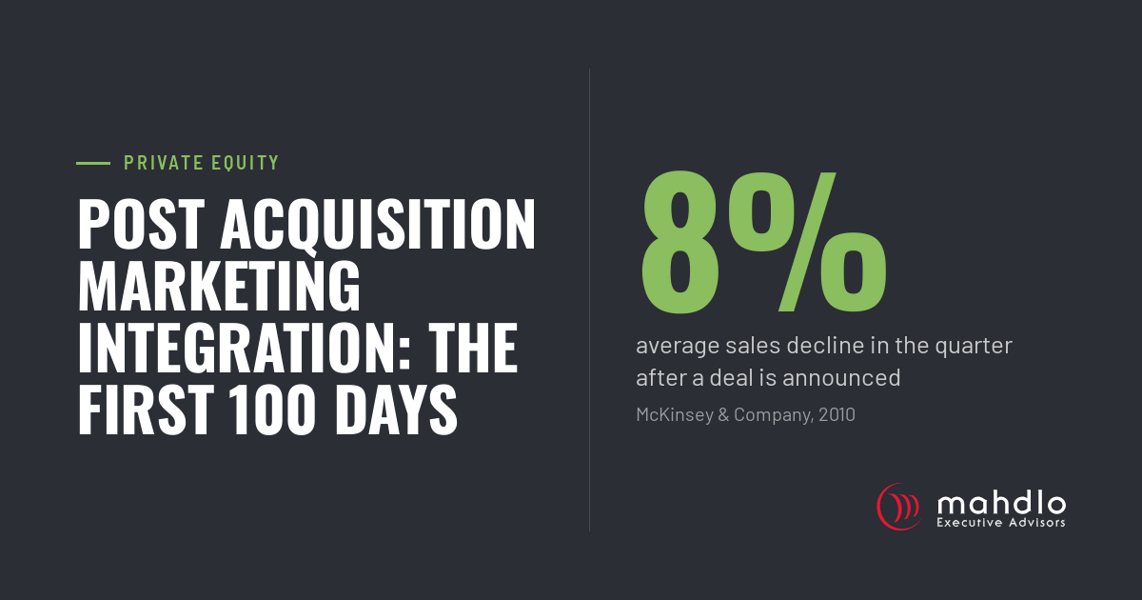
That last one has a price. McKinsey's merger integration research found acquiring companies typically see sales decline 8% in the quarter immediately after a deal is announced, as customer hesitation and internal distraction erode commercial momentum.
Post acquisition marketing integration is a revenue event, not an IT project
Post acquisition marketing integration is the work of merging brand, demand generation, data and revenue reporting from two companies into one commercial engine. It is a revenue event because the deal model's synergy case sits almost entirely in marketing and sales motions, not in systems administration.
The integration PMO view tracks a checklist: systems migrated, logos updated, domains redirected, headcount mapped. Every item can close green while pipeline quietly falls apart. The operating view tracks three things instead: pipeline continuity week over week, customer acquisition cost by combined segment, and cross-sell attach into the acquired base.
That difference decides who should run it. Cross-sell revenue, pricing uplift and demand consolidation all depend on how two sales teams sell and how two marketing teams generate demand. If the person accountable for integration cannot read a pipeline and tell you which stage is thinning, they will deliver a finished project plan and a missed number.
A sequenced 100-day integration plan
Run integration as four moves on a calendar, not a single migration date. Days 1 to 15 are diagnosis: inventory every campaign, every dollar of demand gen spend, every domain and subdomain, both data models, and both pipeline definitions, then put them on one page.
Days 10 to 45 protect revenue in flight. Freeze nothing that is producing. Kill only duplication you have confirmed with spend and conversion data, usually paid search terms both teams are bidding on. Hold customer communications until the message is decided, because a confused email to a shared account costs more than a month of delay.
Days 30 to 75 consolidate. One CRM of record, one definition of a qualified opportunity, one source for the forecast.
Days 60 to 100 execute the brand architecture decision and take the combined narrative to market.
The phases overlap on purpose. Sequential integration takes three quarters. Measurable results in 100 days require them running together.
How to decide brand architecture: absorb, endorse, or hold separate
Three criteria decide it: how much the two customer bases overlap, how much equity the acquired brand holds in its segment, and whether the acquired name carries category or regulatory credibility the parent does not have. Absorb means the acquired name retires and the parent brand takes the market. Endorse means the acquired name stays in front with the parent attached, usually for 12 to 24 months. Hold separate means two brands, two narratives, one commercial engine underneath.
Decide it on evidence, not preference. Pull win/loss notes from the last four quarters, branded search volume for both names, and 10 to 15 customer interviews across both bases. If buyers search the acquired name by name, renaming it transfers that demand to nobody. Rebuilding branded search volume after a premature rename typically takes two to four quarters, and the pipeline gap shows up in the same window the sponsor is asking for synergy capture.
Who should own the integration
One marketing executive owns the integration, reporting jointly to the CEO and the sponsor. Not a committee, not a steering group, not two leaders splitting the work by function.
Promoting one of the two incumbent CMOs feels tidy and costs you a quarter. The leader who is passed over disengages or leaves, usually within 90 days, and takes the acquired team's context with them. The one who wins is now asked to audit their own spend, grade their own agencies, and decide which of their people stay. That is a conflict no one resolves quickly.
An outside integration lead has no team to protect and no budget to defend. A fractional CMO who has run this before can hold the pipeline, consolidate the data, and hand over a working engine, which is executive revenue leadership without the full-time overhead.
On part-time versus full-time: hire the permanent CMO for the combined company you will be running in 18 months, not for the 100 days of merging two of them.
The metrics the sponsor should demand at day 30, 60 and 100
Three reporting milestones, each with four or fewer measures. At day 30, expect one written pipeline definition both teams use, a baselined combined pipeline coverage ratio against the next two quarters, and a dollar figure for identified duplicate spend across paid search, events and agency retainers.
At day 60, expect a single CRM of record with migration complete, customer acquisition cost reported by combined segment rather than by legacy entity, lead response time measured in minutes, and a retention read on the top 20 accounts from each side of the deal.
At day 100, expect a cross-sell attach rate on the combined base, synergy capture tracked line by line against the revenue assumptions in the deal model, and forecast variance narrowing toward the band the board will accept, typically 10 to 15 percent at this stage.
These are reporting ranges and operating targets. They are not guaranteed outcomes, and any advisor who presents them as guarantees is selling you something.
Where AI helps in integration, and where it does not
AI earns its place in the data work: deduplicating accounts and contacts across two CRMs, mapping two product and industry taxonomies to one, clustering overlapping customer bases to find the real cross-sell list, and compressing a content audit of several thousand assets from three weeks to three days. It does not decide anything that requires judgment about people or markets.
Use it where the input is structured and the volume is high. Two mid-market CRMs with 40,000 contacts between them will produce thousands of probable matches, and a model will surface and score them far faster than an analyst working queue by queue. A human still reviews the exceptions and owns the merge rules.
What AI will not do is choose your brand architecture, rebuild trust with an acquired team that just lost its leader, or sit with a nervous customer and explain why the change is good for them. Force multiplier under human judgment. That is the whole rule.
Start this week
Put the two demand gen spend reports and the two CRM stage definitions side by side on one page, and mark every place they disagree. That page is the first page of your integration plan, and it takes an afternoon, not a workstream.
We step into integration work as the single accountable marketing or revenue executive, running the 100-Day Accelerator: Plan to diagnose spend, data and pipeline definitions, Activate to protect revenue in flight and consolidate onto one system of record, Accelerate to land the brand architecture decision and the combined go-to-market narrative. The phases overlap on purpose. Where specialized capability is needed, paid media execution or website build, vetted partners do that work inside the engagement and report into the same plan. You get executive revenue leadership without the full-time overhead, and measurable results in 100 days.
Start with the disagreements. Everything else in the plan follows from them.
Related reading
Explore how Mahdlo Advisors combines strategy and execution to foster sustainable business growth. Discover tailored insights and innovative solutions.
See how we work →Where is your engine leaking?
Get a senior read in 30 minutes.
Not ready to talk? Get the go-to-market playbook →