

The SaaS Scaleup Marketing Operating System,
Explained
A SaaS scaleup marketing operating system has four parts. Learn how to score fractional CMO offers by operating depth, ARR stage, and what you keep after.

The deck landed. The positioning got sharper, the ICP got tighter, and the board liked the slides. Six weeks later, nobody owns Monday. The weekly pipeline review slips, two channels got half-funded, and the CEO is still the person asking marketing where next quarter's pipeline is coming from.
A SaaS scaleup marketing operating system is the planning cadence, demand engine, pipeline math, and team architecture that keep marketing producing pipeline every week without a founder holding it together. It is not a strategy document. It is the set of recurring mechanics that turn a strategy into pipeline you can forecast.
Most marketing leadership offers get evaluated on credentials and cost. That is the wrong filter for a company between $10M and $100M in revenue. What separates an engagement that works from one that produces another deck is the operating model behind it: who runs the cadence, who populates the dashboard, and who owns the number when the advisor is not in the room.
This post gives you a way to score that.
The four components of a SaaS scaleup marketing operating system
A marketing operating system is four connected parts: a planning cadence, a demand engine, pipeline math, and a team and vendor architecture. Each one has an owner, a meeting, and an artifact. If any of the four is missing, the other three degrade within a quarter.
- Planning cadence. A quarterly plan with three to five priorities, a monthly review against target, a weekly pipeline stand-up attended by sales and marketing, and one named owner for each. Not a calendar invite. A decision forum.
- Demand engine. Two or three channels resourced to a number, not eight tested at a level too thin to read. Each channel carries a target for opportunities created and a review date.
- Pipeline and funnel math. Written stage definitions, stage-to-stage conversion rates, sales cycle by segment, and a coverage ratio you hold the forecast to.
- Team and vendor architecture. Who does the work in-house, which specialized capabilities sit with vetted partners, and who reviews the output.
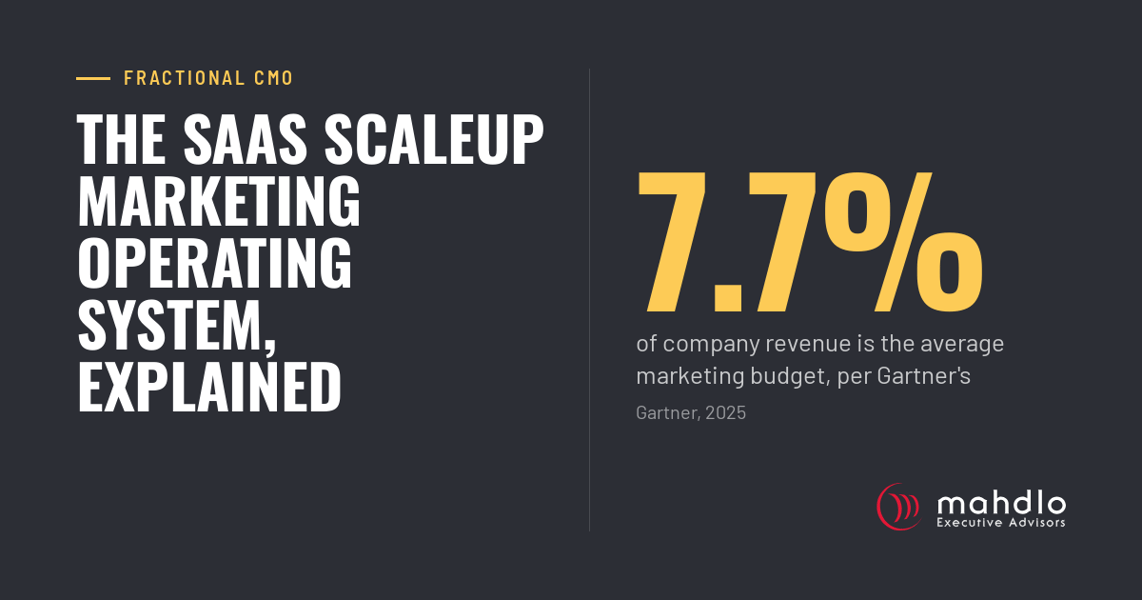
Sequencing matters more than spend. Gartner's 2025 CMO Spend Survey found budgets flat at 7.7% of company revenue for a second consecutive year, with 59% of CMOs saying their budget cannot execute their strategy. More money will not fix an engine with no operating discipline behind it.
Installed versus advised: the difference you are actually buying
Advised means you get a recommendation you then have to staff, fund, and chase. Installed means the cadence runs on a calendar, the dashboard is populated with current data, and someone other than you owns the number.
The tells are easy to spot. Advised looks like a strategy document, a positioning workshop, a channel recommendation, and a check-in call. Installed looks like a Monday pipeline review with sales and marketing in the same room, stage definitions both teams agreed to, and a named person who reports the coverage ratio whether or not you ask. Harvard Business Review estimates sales and marketing misalignment costs businesses more than $1 trillion a year in lost productivity. That cost is not a thinking problem. It is an operating problem.
Installed has a shape you can check against. By day 30, stage definitions are agreed and the weekly cadence is on the calendar. By day 60, the dashboard is live and one channel is resourced to a target. By day 90, your team is running the review without the advisor in the chair.
Diagnose the operating model you need by ARR stage
Your ARR band tells you how much operating depth to buy. Three transitions break most SaaS scaleups, and each one breaks differently.
At $5M to $15M, the founder is still the best closer and marketing is lead supply through one repeatable channel. What breaks is founder capacity and the absence of stage definitions, so nothing forecasts. Buy part-time senior direction plus hands-on execution help. You need someone who will write the stage definitions, not review them.
At $15M to $30M, you have one repeatable motion and need forecast-grade funnel math behind it. What breaks is channel concentration, usually one source carrying more than half of pipeline, and a sales handoff nobody owns. Buy an operator who runs the weekly cadence and builds a second and third channel to a target.
At $30M to $50M, you are multi-segment or multi-product. What breaks is one generalist team serving two conflicting motions. Buy segment-level planning and a deliberate vendor architecture, with in-house owners for the work that compounds.
Three fractional CMO operating models, compared
Fractional CMO engagements come in three shapes: advisor-only, player-coach, and embedded operator with a team behind them. The difference is who does the work on the four days a week the CMO is not in your building.
Advisor-only covers strategy, positioning, plan review, and coaching your marketing leader. Your team executes. It works when you already have three or more marketing people and a functioning cadence that needs direction. It fails outright when there is no team to direct, because the plan has no hands.
Player-coach covers the plan and the highest-leverage execution, typically the demand engine and pipeline reporting, while your team carries the rest. Fits $10M to $25M with one or two marketers in seat.
Embedded operator brings vetted specialists for the work you should not hire for yet, with the fractional CMO directing and reviewing it. Fits a thin team or a multi-segment motion.
On part-time versus full-time: two or three days of senior judgment beats five days of a first-time CMO. Buy full-time when the team exceeds roughly eight people.
The diligence questions and artifacts to demand
Ask for five artifacts before you sign, and expect them in writing within a week of the proposal. Each one has a strong answer and a weak one, and the difference tells you whether you are buying an installed operating system or a document.
A written 90-day install plan with named owners. Weak answer: a phased approach described in verbs with no names and no dates.
The name of the person who runs the weekly pipeline stand-up. Weak answer: "we will work with your team on cadence."
A single source-of-truth dashboard and who maintains it. Weak answer: reporting pulled together ahead of the monthly meeting.
The channel and partner roster, marked in-house or vetted partner. Weak answer: a list of capabilities with no line between what the advisor does and what gets subcontracted.
Handoff and exit criteria stating what you own at the end. Weak answer: renewal assumed and nothing written about what transfers.
If three of the five come back thin, keep looking. None of these take a prospective advisor more than a day to produce.
Where AI helps in the operating system and where it does not
AI compresses the research, content production, list building, and funnel analysis inside the operating system. It does not own a cadence, arbitrate a disagreement between sales and marketing, or decide which two channels get resourced to a target.
Three places it earns its keep. Account and segment research that used to take an analyst a week now takes a day or two, which matters when you are rebuilding an ICP at the $15M to $30M transition. Content production against an approved brief, where a writer moves from blank page to reviewable draft in hours instead of days. Funnel analysis, where pattern detection across stage conversion and velocity surfaces the leak faster than a manual pull.
The judgment calls stay human. Which segment you stop serving. Whether a stalled stage is a product problem or a qualification problem. What happens when your VP of Sales says marketing's leads are weak and marketing says sales is not working them.
AI makes the system faster. Someone still has to own the number.
How to score the engagement at 90 days, six months and twelve months
Score the first 90 days on installation, not revenue. Four leading indicators tell you the system is real: stage definitions agreed and written down, a single dashboard live and populated, a weekly pipeline cadence that sales and marketing both attend, and one channel resourced to a stated target rather than tested.
By month six, ask for trends, not promises. Qualified pipeline coverage against quota, stage-to-stage conversion, sales cycle length, and cost per opportunity should each show direction across two consecutive quarters. Direction matters more than the absolute number this early.
By month twelve, your team should run the cadence without the fractional leader in the room. If the weekly review collapses when they travel, you bought help, not a system.
We run this as the 100-Day Accelerator, with Plan, Activate and Accelerate overlapping so the cadence and dashboard are live while the plan is still being sharpened, then Sustain after day 100 under fractional CMO or CRO leadership.
This week, pull the last two quarters of pipeline by stage and name who owns Monday's review.
Related reading
Explore how Mahdlo Advisors combines strategy and execution to foster sustainable business growth. Discover tailored insights and innovative solutions.
See how we work →Where is your engine leaking?
Get a senior read in 30 minutes.
Not ready to talk? Get the go-to-market playbook →