

Building a Marketing Operating System That Outlasts You
A marketing operating system is the real deliverable of a fractional CMO: cadence, decision rights, demand model, metrics and playbooks that keep running.

You are on your third marketing leader in four years. Each one arrived with a fresh strategy deck, a new set of channels, and a ninety-day plan. Each one left before the plan produced a predictable quarter. Pipeline is still lumpy. Sales still says marketing sends the wrong leads. Marketing still says sales does not work the ones they send. The deck changes every time. The results do not.
The gap is rarely strategy. It is the absence of a marketing operating system: the documented cadence, decision rights, demand model, metrics and playbooks that let marketing run the same way whether or not any one leader is in the seat. Strategy tells you where to go. The operating system is what keeps the company going there when the quarter gets hard.
This post covers what a marketing operating system actually contains, how it differs from the deck it gets confused with, how it gets installed in the first 90 days, how to size it to a $10M or $150M business, and how to inspect it in an hour a month.
A marketing operating system is the five things that make marketing repeatable
A marketing operating system is the set of five artifacts that let marketing produce the same output every quarter regardless of who holds the pen. Get all five in place and a new leader inherits a running machine instead of a blank page.
The five:
- Planning cadence. A fixed rhythm of weekly pipeline reviews, monthly plan revisions and quarterly resets, with dates on the calendar.
- Decision rights. Who sets priorities, who approves spend, who breaks a tie between sales and marketing.
- Demand model and forecast. The math from spend and activity to pipeline to closed revenue, with stated conversion assumptions.
- Metric tree and reporting layer. One number at the top, decomposed into the inputs a team can actually move.
- Documented playbooks. The plays that work, written so someone else can run them.
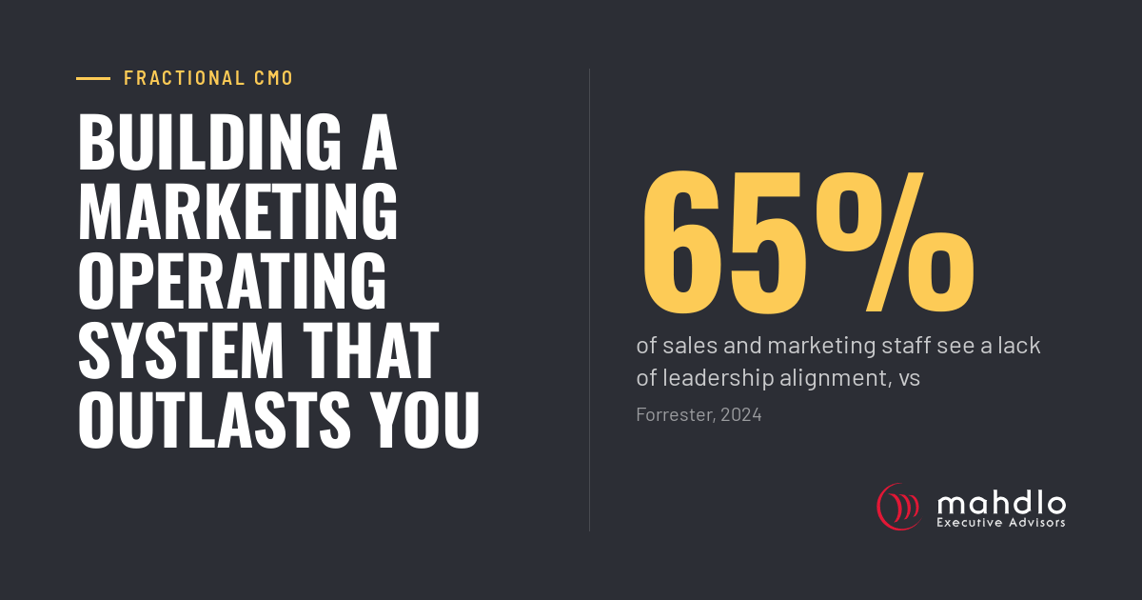
The tells are reliable. Recurring arguments about priorities means decision rights are missing. Misses that surprise you 30 days out means the demand model is guesswork. And assume less alignment than you see: Forrester's Q2 2024 Sales and Marketing Alignment Survey found 65% of sales and marketing professionals see a lack of alignment between their sales and marketing leaders, while Forrester's 2024 Priorities Survey found 82% of C-level B2B executives believe those teams are aligned.
A strategy deck is not an operating system
A deck describes intent. An operating system encodes how decisions get made when that intent meets a missed quarter, a competitor price cut, or a rep who needs pipeline this month. The deck is the output of one person's thinking. The system is the set of meetings, owners, models and documents that keep working after that person's calendar changes.
This is why the third marketing leader in four years starts over. There is nothing to inherit. No cadence, no demand model with last year's assumptions written down, no record of which plays produced revenue and which were quietly abandoned. So they do the only rational thing and build a new deck, and the 90 days it takes to build it is 90 days the pipeline does not improve.
That gap is also the honest answer to what part-time leadership delivers. A consulting engagement hands you recommendations. Installed leadership runs the cadence, makes the calls in the room, and leaves behind artifacts a competent internal owner can operate. Strategy plus execution.
What a fractional CMO installs in days 1-30, 31-60 and 61-90
The system gets built in three overlapping phases, and each one ends with a decision only you can make. Plan runs days 1-30, Activate runs 31-60, Accelerate runs 61-90. That is how we sequence the 100-Day Accelerator, and it is why measurable results in 100 days is a schedule rather than a slogan.
Days 1-30: a baseline of current pipeline by source, a metric tree that connects marketing activity to revenue, a first draft of the demand model, and written decision rights. Your gate decision is approving the number the model commits to.
Days 31-60: the planning cadence goes live, the reporting layer replaces ad hoc updates, and two plays run in market. Your gate decision is which two, and what you stop funding to pay for them.
Days 61-90: the forecast is tested against actuals and the playbooks are documented. Your gate decision is who inside the company owns this next.
Quarters two through four are Sustain. The internal owner runs the cadence, plays expand from two to four or five, and the model gets recalibrated each quarter against what actually closed.
Size the operating system to the company, not to the last one you saw
The right operating system is the smallest one that makes next quarter predictable. At $10M, that is a weekly 45-minute pipeline review, one owner who holds both marketing and pipeline, a one-page demand model, and two documented plays. At $50M, add a monthly plan review with the sales leader, a named demand generation owner separate from the content owner, a metric tree that traces campaign to closed revenue, and four to six plays. At $150M, you need a quarterly planning cycle with dated revisions, a marketing operations role that owns the reporting layer, segment-level demand models, and playbooks maintained by the people running them.
The common failure is installing enterprise process into a 30-person team. You get compliance theater: meetings held because the calendar says so, dashboards nobody acts on, and slower decisions than before.
As a working range, a $10M team absorbs roughly two to three standing meetings a month, $50M four to six, $150M eight to ten. Treat those as ranges, then cut one.
How to inspect the system as CEO in one hour a month
You inspect the system by reading four artifacts, not by sitting through a marketing update. Block 60 minutes once a month and ask for these in advance: forecast accuracy against the prior quarter, pipeline coverage by source, a campaign-to-revenue trace for the two largest plays, and the living plan document with dated revisions.
Activity reporting hides the gap. Impressions, MQL counts, and content shipped all move up and to the right while pipeline stays lumpy. If the deck you receive is mostly activity, the operating system does not exist yet.
Ask these five questions, verbatim:
- What did we forecast for last quarter, what did we close, and what explains the variance?
- What is pipeline coverage against next quarter's number, broken out by source?
- Which campaign produced the last five closed deals, and can you trace the path?
- When was the plan document last revised, by whom, and what changed?
- What decision are you waiting on from me?
Five clear answers in 60 minutes means the system is running. Hedging on two or more means it is not.
The handoff test: what survives when the fractional CMO leaves
The test is one question. Could a competent internal owner run next quarter's full cycle, planning through reporting, from the documentation alone, without calling the person who built it. If the answer is no, you bought a temporary leader, not an operating system.
Documentation standards are simple. Each play has an owner, a trigger, a budget range, a target metric and a stop condition. The demand model shows its assumptions and where the inputs come from. The plan document carries dated revisions so anyone can see what changed and why.
Internal owner development starts in month two, not month nine. That person sits in the cadence, runs one meeting by day 60, and owns the forecast conversation by the end of the second quarter.
When the handoff is skipped, the decay is predictable. Cadence lapses first, usually within two quarters. The demand model goes stale next because nobody refreshes conversion assumptions. Then reporting reverts to activity, and you are back to impressions and content counts.
We build the handoff into the engagement from day one: a named internal owner, documented plays, and a forecast the team runs without us. Fractional CMO and Fractional CRO leadership through the 100-Day Accelerator gives you executive revenue leadership without the full-time overhead, and Sustain after day 100 exists to prove the system holds.
Start with one artifact this week
Write down the last four marketing decisions your company made and who actually made each one. Then write down who was supposed to make each one. That one page, which takes about 30 minutes to produce, tells you whether decision rights exist or whether they are assumed.
Pick decisions with money or time attached. A campaign that got funded. A segment you stopped pursuing. A pricing test. A hire or a vendor. For each, name the person who made the call, the date, and where the decision is recorded. If you cannot find the record, that is the finding.
When the two columns match on all four, your operating system has a spine and you can move to the demand model next. When they diverge on two or more, you have located the reason priorities keep getting relitigated, and you have it in writing rather than in a meeting.
Do this before your next leadership meeting. Bring the page. Ask the room to reconcile the differences in twenty minutes, and put the agreed owner for each decision type in the document that day.
Related reading
Explore how Mahdlo Advisors combines strategy and execution to foster sustainable business growth. Discover tailored insights and innovative solutions.
See how we work →Where is your engine leaking?
Get a senior read in 30 minutes.
Not ready to talk? Get the go-to-market playbook →